Media

Listen to the podcast episode:
Guest Profile: Isaak Tsalicoglou is a mechanical engineer by training, a long-time Linux enthusiast (since 1997), and an experienced open-source developer. He serves as the managing director of his family’s industrial equipment trading business in Greece.
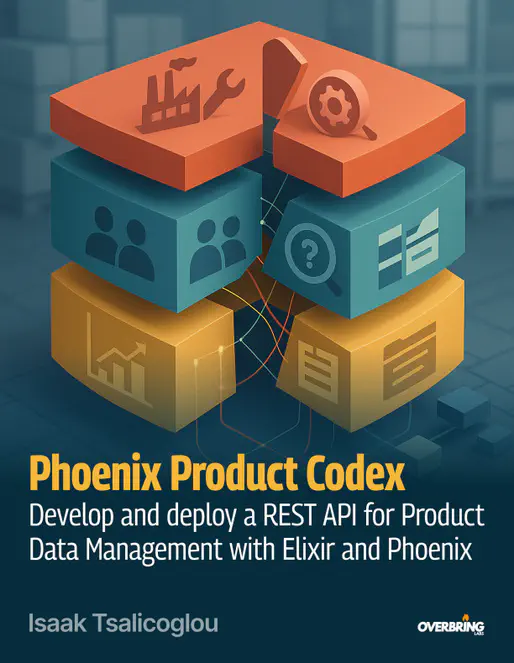
Book Focus: The podcast highlights his latest book, Phoenix Product Codex: Develop and Deploy a REST API for Product Data Management with Elixir and Phoenix .
The Business Challenge: When Isaak returned to Greece from Switzerland, he stepped back into his family’s legacy business, which had survived the severe Greek economic crisis by relying on manual processes, Excel sheets, and paper documents. Preparing a single client quote took 30 to 60 minutes due to uncodified inventory items.
The Government Mandate: Around 2021, the Greek government introduced “myDATA”, a mandatory electronic invoicing REST API intended to digitize tax submissions and dismantle traditional bureaucracy.
The First Solution: Lacking knowledge of Elixir at the time, Isaak built a scrappy, functional REST API suite using Python to issue product codes and satisfy government requirements.
The Elixir Re-implementation: Phoenix Product Codex is a complete, production-ready re-implementation of that running system using Elixir and the Phoenix framework. The new architecture dropped quotation generation times from roughly an hour down to under 5 minutes, automatically rendering PDFs and tracking codes.
Demystifying Tech for Business Leaders: Host Len Epp and Isaak discuss why modern business leaders (such as MBAs) can no longer afford to avoid understanding software development. Isaak explains a REST API as an HTTP-based data contract. He notes that his book implements both standard JSON payloads and plain text responses to easily interact directly with corporate spreadsheet software like Microsoft Excel or LibreOffice.
The Concept of “Satisficing”: Isaak advises engineers and business owners to choose practical trade-offs over chasing a perfect, abstract “platonic ideal” of code. Software should hit the point of diminishing returns where it effectively solves the business bottleneck rather than over-engineering minor edge cases.
Change Management: Even in a tiny five-person company, rolling out new tools requires stepping away from a pure technical “nerd zone” to listen to end-users (such as logistics managers or accountants) and guide them through fast iterative loops.
Taxonomy and Domains: A major segment of the book’s first chapter breaks down product taxonomy. Isaak details why a company must isolate its Catalog Domain (internal sales configurations) from the Supply Domain (external supplier product data codes) to cleanly manage complex, non-linear relationships such as kitting out spare parts.
Production-Grade Features: Unlike simplistic entry-level coding guides, this text handles production-ready architectural concepts, including:
Iterative Writing Progress: Isaak emphasizes the efficiency of writing directly in Markdown via VS Code. While his first book (Northwind Elixir Traders ) took a full year to finish, this book is moving twice as fast due to established gut feelings regarding how deep to explore particular architectural side-quests without getting bogged down. The book is projected to span roughly 450 pages.
Leanpub Pricing Strategy: Isaak utilizes Leanpub’s variable lean-publishing pipeline by offering heavy early-bird discounts (e.g., via the Elixir Forum) and incrementally raising the price as chapters are completed. This setup functions as a valuable feedback mechanism, rewarding early adopters with a lower entry fee while giving them direct avenues to shape the text’s development.
Feature Requests for the Platform: When asked for platform improvements, Isaak requests a localized, unified visual dashboard to aggregate sales figures and royalties metrics across multiple publications. He also notes the formatting challenge where his favorite typography choice, IBM Plex Mono, had to be discarded for DejaVu Mono due to a lack of native support for the Greek alphabet.